

Cecco
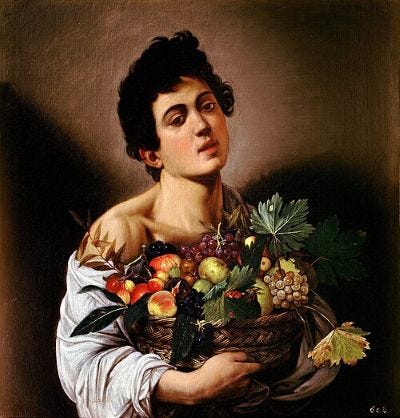
Francesco Buoneri, known as Cecco, was a model for the renowned Baroque painter Caravaggio. He was also his apprentice, and likely, his lover.
Author’s Note
A warm welcome to my new followers and subscribers and greetings to all. The poem that follows is part of a series dedicated to highlight queer love through the ages.
BACKGROUND
The renowned Baroque painter Michelangelo Merisi da Caravaggio led an unbridled and riotous life. He was notorious for his volatile temperament and impulsive behavior, which he exhibited at taverns where he indulged in heavy drinking and brawling. Often sharing his living quarters with courtesans, laborers, and street boys, he used them as models, rejecting the polished ideal of beauty of earlier Renaissance painters.
Francesco Buoneri was one of the boys thought to have entered Caravaggio’s social circle as one of several models and assistants at his workshop in Rome. Some scholars suggest that Francesco, known as Cecco, posed for several of the artist’s works, gradually becoming his apprentice while engaging with him in an intimate relationship.
Even though there is no definitive proof that Buoneri and Caravaggio were romantic partners, one significant piece of evidence pointing to the existence of a special bond between them, is the fact that Buoneri came to be known by the possessive: Cecco del Caravaggio, literally “Caravaggio’s Cecco,” while other associates of the artist did not receive such public acknowledgment.
Buoneri and Caravaggio lived in a time and place where male love was both socially present and legally punishable. Yet, Caravaggio’s canvases conveyed defiant sensuality and staged intimacy that his contemporaries would have likely recognized. Two examples of this are Amor Vincit Omnia (Love Conquers All), Bacchus, and Boy with a Basket of Fruit. These paintings feature young male figures in provocative poses, rendered with unusually raw, unfiltered realism. This approach aligns with Caravaggio’s tendency to draw models from his immediate environment.
As further suggested evidence of a close and perhaps passionate relationship between Caravaggio and Buoneri, in David with the Head of Goliath, one of Caravaggio’s most dramatic paintings, modern scholars propose that Buoneri may have been the model for David, while the giant’s face is widely interpreted as being a self-portrait of the artist.
Like Caravaggio himself, Buoneri’s life appears to have been marked by controversy. Police records reveal his involvement in violent altercations, hinting at a rebellious spirit and a willingness to challenge societal norms, which paralleled Caravaggio’s lifestyle.
In 1606, after a period working in Rome, Caravaggio fled to Naples after being accused of murdering a gangster from a wealthy family over a gambling debt. Although there is no solid evidence that Buoneri followed him during exile, it is a possibility. What is certain is that his patrons, who had until then been able to shield him from the consequences of his misadventures, were no longer able to protect him. He was declared a fugitive, sentenced to death by the Papal judicial system, and an open bounty was decreed, allowing anyone who captured him to carry out the sentence wherever he was found.
Vatican documents released in 2002 support the theory that Caravaggio was hunted down and killed in the year 1610, as a vendetta for the murder of the wealthy gangster in a botched attempt at castration. He was aged 38.
As for Buoneri, a much younger man than Caravaggio, there are no archival records tracing his movements after 1610. However, some art historians believe he may have become a painter in his own right, forging his own artistic identity.
Cecco
A wrinkle in time opened a window
in this, mine realm,
cold, and well beyond
the weight of mortal breath.
I looked forth and beheld visions
of an Age long gone.
For an instant,
I caught sight of our lives
from the moment my gaze
rested upon you, my sweet Cecco,
still tender and green,
comely and alluring.
You reeked of innocence!
I saw you come of age,
your impish smile
blossoming across your face,
eyes glistering, slick with eros.
I yearned for your embrace,
so, I beseeched you
to slake your thirst in me.
And that, you did.
For six winters, and no less.
Ours was no passing liaison.
Bound together by Destiny,
we were never afeared.
Why would we?
We thrived in perilous terrain,
surrounded by vagrants,
far away from torpid creatures
who drank from steaming goblets
full of wine and gilded tales
of splendor and magnificence.
Not us!
We were not born to be princes,
though we were richly endowed.
We were prodigious spirits
worthy of God’s gifts
bestowed upon us a thousandfold,
when our ebullient minds
turned brushstrokes into marvels.
’Tis true,
we raced through life,
jostling, clawing,
ravenous and relentless
in our quest for deliverance.
I do concede,
We were drunk on carnal spirits.
We craved to hear men’s laughter,
and taste their malt-soaked words.
Was this a mere indulgence or a sin?
Even when we raised our fists
and drew our blades,
did our souls know
our lives were canvases
wrought by Providence Divine?
And then I tempted Fate.
and fell from grace.
O delirious pride!
’Twas foolhardy!
The wiles of the Devil assailed me.
Abominable vultures
came sounding the death knell.
I heard the thud of thwacking blade-on-bone,
a final wheezing gasp,
and I, the great Caravaggio of Lombardy,
had been cast from this earth
unto my eternal abode.
The window closes now.
I see your face fading in the distance.
I cry: “My sweet Cecco, be of good cheer,
for we always stood with the angels!
DCW
If you enjoy my work, I invite you to join a growing constellation of kin souls in a journey into realms yet to be discovered by becoming a FREE subscriber to my Substack.