

Marina's Dream
A common acquaintance brought Marina and Sophia together at a Moscow literary salon in the Autumn of 1914. They quickly became romantically involved. Marina's family thought she had been "bewitched."
Author’s Note
A warm welcome to my new followers and subscribers and greetings to all. The poem that follows is part of a series dedicated to highlight queer love through the ages.
BACKGROUND
Marina Tsvetaeva and Sophia Parnok met at a Moscow literary salon in 1914. At the time, Parnok was twenty-nine and an established poet and literary critic, later referred to as “Russia’s Sappho” for her pioneering portrayal of love between women in Russian literature. Tsvetaeva was twenty-two, was also a poet, and had been married since 1912. Within weeks of meeting, the two women were spending substantial time together despite Tsvetaeva’s marriage. Their relationship appears to have been openly acknowledged within their literary circle, though discretion remained necessary given the social conventions of the time.
Under tsarist law, male homosexual acts were criminalized, while romantic liaisons between women existed in a more ambiguous legal and social space. Female same-sex relationships were often overlooked by authorities, who tended to regard them as private matters confined to elite artistic and social circles. The 1917 Revolution did not immediately alter these attitudes. In later decades, however, the Soviet state increasingly promoted rigid norms of sexuality and family life. Although female homosexuality was never explicitly criminalized in Soviet law, it was frequently stigmatized and, at various times, treated as a pathology or mental disorder.
The surviving record shows that Tsvetaeva and Parnok’s relationship developed rapidly into a bond that was at once romantic, erotic, intellectual, and emotionally turbulent. One of the strongest pieces of evidence is Tsvetaeva’s poetry cycle The Girlfriend, dedicated to Parnok, which intertwines tenderness, love, bitterness, and forebodings of separation and doom. Parnok’s poems from the same period likewise portray their connection as a love affair rather than a platonic friendship.
Yet, even as their relationship deepened, many people around Tsvetaeva did not regard it as “real.” Contemporary accounts often described the affair as a temporary fascination or a kind of “spell” from which she would eventually awaken. The implication was that Tsvetaeva had been somehow “bewitched,” and was therefore not fully responsible for her feelings. Parnok, as the older woman, was frequently cast as the “real” lesbian and presumed seducer who had initiated the relationship. Ironically, researchers suggest that it was Tsvetaeva who actively pursued Parnok before they became a couple.
The relationship ended in early 1916. The separation appears to have unfolded gradually rather than as a result of one dramatic event. The poems both women wrote afterward reveal that the parting was painful and due to differences in temperament and Tsvetaeva’s marriage and family obligations. Tsvetaeva, in particular, continued to remember the affair for years, and later referred to Parnok as one of the great loves of her life.
Although their paths diverged, the two poets remained linked through literary history. Parnok continued writing and living independently, dividing her time between Moscow and Crimea. She died of heart disease in 1933 at the age of forty-seven, at a time when her literary reputation had already begun to fade under the changing cultural climate of the Soviet Union. Tsvetaeva went on to become one of the towering figures of 20th-century Russian literature though her life was marked by extraordinary hardship. During the Moscow famine, she was forced to place her daughters in a state orphanage, where one of them died of hunger in 1919. In 1922 she emigrated with her family and spent years in poverty across Europe before returning to the Soviet Union 1939. Soon afterward, her husband was executed and her surviving daughter was sent to a labor camp. Isolated, impoverished, and facing wartime upheaval, Tsvetaeva died by suicide on August 31, 1941. She was forty-eight years old.
Despite the efforts of both pre- and post-revolutionary institutions to impose narrow definitions of identity, the lives and work of these remarkable poets endured. Their queer identities could not be erased by those who sought to deny the truth of their experiences and suppress or diminish their place in literary history.
Marina’s Dream
after Marina Tsvetaeva and Sophia Parnok
Sophia, my love:
When word reached me
that you were gone from the world
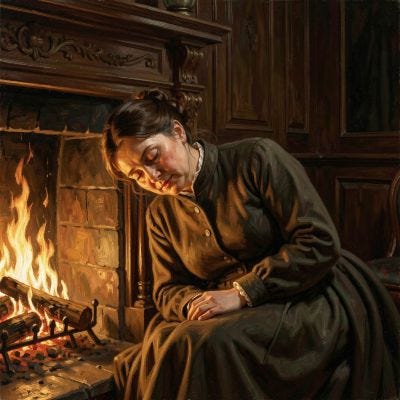
I sat by the hearth
and closed my eyes.
A dream opened a window
and memories of us
flowed in.
I saw our truth,
fierce and defiant,
without apology,
without disguise.
Even when they called it
a spell, a passing trance,
I was still your Marina,
and you, my Sophia.
And though we were confined,
they never succeeded
at making us less real.
What I would have given
to have another chance
to stay together a few heartbeats
beneath time’s slower wing.
Instead, we were brief—
our love interrupted
by history’s blunt hand.
Yet long after we
settled into stillness,
here I am in what remains,
still dreaming,
still weeping in silence.
DCW
If you enjoy my work, I invite you to join a growing constellation of kin souls in a journey into realms yet to be discovered by becoming a FREE subscriber to my Substack.
Thank you, Daniel. Your poem is lovely. The backstory you provide is enlightening.