

My Sanctuary
Elizabeth I was queen when a powerful lord, and member of her court, brought a controversial playwright under his wing. The two men developed a deep bond that survived accusations of sodomy...
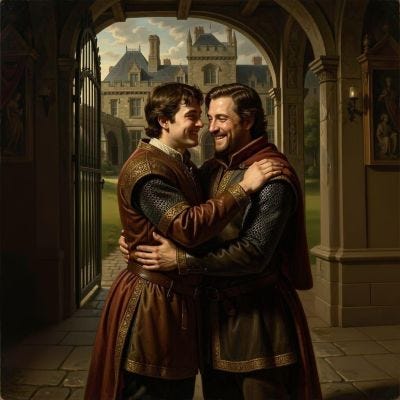
Author’s Note
A warm welcome to my new followers and subscribers and greetings to all. The poem that follows is part of a series dedicated to highlight queer love through the ages.
BACKGROUND
Sir Thomas Walsingham was a wealthy landowner and courtier during the reign of Queen Elizabeth I. He was likely introduced to Christopher Marlowe, an emerging playwright and poet who is widely thought to have experienced same-sex attraction, through a mutual acquaintance. Both men were in their twenties.
Walsingham and Marlowe developed a close personal relationship that deepened over the years. By 1590 Walsingham had become Marlowe’s principal patron, with Marlowe frequently staying as a guest at Scadbury, one of Walsingham’s country estates. Between 1591 and 1593, during the plague, Marlowe appears to have made Scadbury his principal residence.
In Elizabethan England, aristocratic households often included scholars, artists, and clients who lived with their patrons. Such arrangements were not, by themselves, unusual. However, unlike many patrons who merely dispensed gifts and money, Walsingham continued to provide Marlowe with patronage, lodging, and protection, even after he faced serious charges of alleged heresy before the Privy Council in the year 1593. Some accusations centered on his alleged statements about same-sex love, which were cited as proof that he was a sodomite and actively engaged in blasphemy.
No private correspondence between Marlowe and Walsingham survives, so the exact nature of their relationship remains unknown. However, historians have been able to reconstruct it from legal records, dedications, government documents, and contemporary accounts. Collectively, these sources suggest a close and enduring association that lasted until Marlowe’s death in May of 1593 at the age of twenty-nine.
Although Marlowe’s writings cannot reveal the nature of his relationship with Walsingham, they do show a recurring fascination with male beauty and male-male affection. In the play Edward II, which centers on a tragic love between the king and one his favorite companions, Piers Gaveston, Marlowe boldly portrays the characters in sympathetic terms, rather than as culprits in a crime of vice. In Hero and Leander, Marlowe writes of the male youth Leander’s looks as “all that men desire...” And in the play Dido, Queen of Carthage he begins with a homoerotic scene between Jupiter and Ganymede.
Independently of Marlowe’s writings, some scholars have noted that the unusual closeness of his relationship with Walsingham invites questions that the surviving evidence cannot definitively answer. Arguments for a romantic interpretation rest largely on their prolonged shared domestic life, Walsingham’s unwavering support during Marlowe’s legal troubles, and his continued stewardship of Marlowe’s literary legacy after his death.
Walsingham spent much of the remainder of his life at Scadbury Manor, where he died in the autumn of 1630 at the age of sixty-nine. Whatever the true nature of his relationship with Marlowe, the surviving evidence has never settled the question of whether their bond was anything other than purely platonic, leaving room for differing interpretations.
My Sanctuary
after Sir Thomas Walsingham & Christopher Marlowe
Could mine eyes look back
upon times we once shared,
then kind Sir, suffer me this liberty of speech
as I catch the past in a net
and distill veritable sentiments
from scattered dreams.
When fear made every path uncertain
and whispers whetted idle tongues,
thou wert my sanctuary.
When wicked men set out
to weigh my soul,
thy door stood fast against them.
Thy presence comforted me
more than the warmest hearth in winter.
Thy voice brought ease
deeper than a summer breeze.
Thy hand lay but an instant upon mine
yet remained a promise in my heart.
In truth, I loved thee.
This was no flight of fancy.
Whether the world would name such sentiments
the faithful kindness of one man toward another,
or something even more tender still,
I leave that unto the living.
Yet history shall never find the words
that passed between us
when no witness kept the hour.
The Lord alone beheld the whole account
and He alone could name
the devotion we bore unto each other.We now dwell in a place where charges of heresy and blasphemy have no dominion. Should thy spirit ever marvel whether thy kindness was forgotten, I do proclaim my gratitude to thee eternal.
And so, my good Lord Walsingham,
pray keep this one assurance:
I count thy graces and companionship
my haven,
and the most blessed of mercies
the Lord ever bestowed upon me.
DCWIf you enjoy my work, I invite you to join a growing constellation of kin souls in a journey into realms yet to be discovered by becoming a FREE subscriber to my Substack.
We will rarely know for certain whether relationships between men 400 years ago, or more, were homo-erotic, homo-amorous, or homo-romantic because the social customs, mores and the relationships between men and women or between men were not as they are today. They certainly loved each other - as brothers, as intelligent and educated men, as close friends, maybe as sexual lovers. Men, often strangers, shared a bed to keep warm or simply to sleep.
I usually enjoy your writing and I have no wish to detract or disagree with your romance. I send my thanks and appreciation.
Genetically, there are several genes in both men and women that can appear in DNA to make any humans (primates or other mammals) to be more or less likely to behave bisexually or homosexually.