

Piers
In 1300, Prince Edward of England fell for Piers Gaveston, the son of a knight in his father's court. The king banished Gaveston to France. Then Edward succeeded him and everything changed...
Author’s Note
A warm welcome to my new followers and subscribers and greetings to all. The poem that follows is part of a series dedicated to highlight queer love through the ages.
BACKGROUND
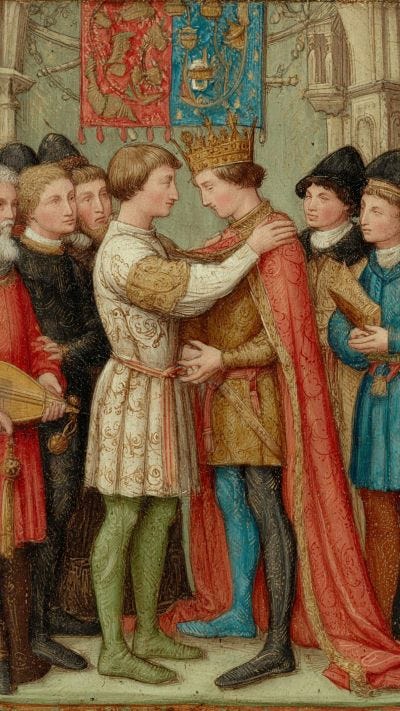
Piers Gaveston was the son of one of the knights in the court of King Edward I of England at Eltham Palace. In the year 1300, he became acquainted with the king’s son, Prince Edward, who was 15, and not much younger than him. The two teenagers were described by their contemporaries as strong, handsome, and sharing an interest for outdoor activities as well as music. The pair developed a close relationship which did not go unnoticed. One chronicler recorded that, upon looking at Gaveston, the son of the king immediately felt such fervor for him that “a bond of indissoluble love” was formed between them, “firmly drawn up and fastened with a knot.”
This special bond between Prince Edward and Gaveston did not please the king, who decided to banish Gaveston to France in 1307. Devastated, the Prince lavished Gaveston with fine gifts and even rode with him to the port of Dover with two minstrels to see him off.
Soon afterward, the king died and Edward ascended the throne as King Edward II. He immediately proceeded to invite Gaveston back to England and granted him the Earldom of Cornwall, one of the wealthiest and most prestigious in England, a privilege traditionally reserved for a member of the royal family. Since Gaveston was the son of a knight (a soldier, rather than a landed lord), the earls felt this debased the dignity of the peerage. The established English earldoms were held by men with ancient bloodlines whose families had controlled massive swaths of land for generations.
The following year, to secure succession, Edward decided to travel to France and marry Isabella, aged 13, daughter of King Philip IV. At that time, he appointed Gaveston to act as regent in his absence, a role typically assigned to a close royal relative. At their coronation feast, Edward notably ignored Isabella in favor of Gaveston, whose unconventional closeness to the king and the special favors he received from him, further offended some of the barons, who demanded he should be exiled, and have his earldom removed. To appease them, Edward appointed Gaveston Lieutenant of Ireland.
By 1309 the opposition of the barons had been somewhat relaxed, and Edward was able to recall Gaveston to England. Their close relationship was quickly reestablished and intensified to such degree that Edward began to refuse to see the barons unless Gaveston was present, often delegating the appointment and removal of ministers to Gaveston. Over time, many came to believe that Gaveston had usurped royal power and labeled him a traitor.
Eventually, the opposition to Gaveston solidified into formal demands for his permanent exile, but the king refused to part ways with him. The barons raised an army against the king and proceeded to capture, try, and condemn Gaveston as a traitor. He was beheaded on June 19, 1312. Edward II was grief-stricken and swore revenge. After 15 years of political turmoil, he was eventually deposed in January of 1327 dying under mysterious circumstances in September of the same year.
Piers
Unfurling visions of Eltham,
when fields were wide,
the air keen with hawk and horse
stir memories of thee,
my noble Piers, my sworn companion,
and the day we first beheld each other,
and knew at once,
our hearts had chosen.
Young and strong we grew
beneath my father’s gaze
until the crown was mine.
‘Twas I, Edward II, King of England,
who placed Cornwall in thy hands,
Alas, the barons bristled,
their wounded ancient pride,
blinding them with wrath.
Poisoned whispers, sharp as daggers
named thee traitor and usurper
and cast thee from my court,
time and again,
still our bond grew stronger.
June wind moved through the grass,
when the wicked seized thee,
merciless steel glinting in their hands
before they struck thee from this earth.
The realm stood silent,
my soul in ruins.
Fifteen winters passed in silence.
Vengeance I vowed,
thy absence echoing
in halls bereft.
My crown grew heavy.
My foes, the hounds of doom,
circled as wolves about a wounded stag,
then pounced
until my shell was of this world no more.
Now we lie beyond their reach.
No baron may come between us,
no council decree thy exile.
The strife of old kingdoms
has faded like thunder in the distance.
And even death,
this cold dominion,
cannot undo the ties that bind
our hearts together
in everlasting union.
DCW
If you enjoy my work, I invite you to join a growing constellation of kin souls in a journey into realms yet to be discovered by becoming a FREE subscriber to my Substack.
Wow. This is both educational and powerful stuff. Thank you. D. C for bringing it to everybody's awareness. I'd say you're bringing the past to life, but in some ways, history repeats itself. In some countries over in the Middle East, Africa and also across here in Asia, we could argue that things are similar. So often easy to forget that there are still many countries in the world where loving who you love, and being who you are is considered a crime with physically painful consequences.
Once again thank you for your prose and your thoughtfulness.
Fated divine love. two souls born and bonded for eternity. a love that last from the beginning to eternity. Beautiful. The poem touched my heart.